
Occupational Training Through Micro-credentials
Occupational Training Through Micro-credentials By Dr Felix Quayson The complexity of the future of work requires us to re-think training for occupations and careers. In the modern age, there would be non-traditional and traditional ways to define what an occupation/career should be or look like because of advanced knowledge and technologies in the world. To re-structure our thinking of occupational training, we need to explore micro-credentials in professional learning and development. Micro-credentials are skills-based competencies that enable individuals to demonstrate knowledge and skills in a specific career or occupation, culminating in a digital badge or certification. An effective micro-credential program is one that leads a person to demonstrate trained competencies examined by experts and professionally trained evaluators/assessors against a rubric. In this excerpt, I make the case for institutions, organizations, and training centers involved in career and occupation training to integrate micro-credentials into their course designs, curricula, and educational programs. This approach would give students or learners an advantage by allowing them to demonstrate their skills-based competencies when applying for jobs. “To re-structure our thinking of occupational training, we need to explore micro-credentials in professional learning and development” Undergraduate Programs I would encourage undergraduate programs to integrate micro-credentials into courses, curricula, and academic programs. In any course syllabi, there are learning objectives/outcomes that each faculty member would like the students to achieve. However, students rarely receive recognition for achieving learning objectives or outcomes with micro-credentials, as opposed to receiving letter grades. For example, a business course would have the learning objectives/outcomes of at the end of this course, students will demonstrate foundational knowledge and application of concepts and theories in marketing, accounting, management, and economics. “students rarely receive recognition for achieving learning objectives or outcomes with micro-credentials, as opposed to receiving letter grades” Students will complete the course for a letter grade and there is no indication of a micro-credential embedded within the course. In this case, students should earn micro-credentials because they were able to demonstrate foundational knowledge and applied the concepts and theories of marketing, accounting, management, and economics in business environment. These students will be able to demonstrate to employers their advanced knowledge and training in accounting, marketing, economics, and management leveraging this in the job search process because an expert and professionally trained assessor (faculty member) has examined these competences against a course rubric. Undergraduate programs that integrate micro-credentials into academic programs will create an identity of advanced knowledge and skill competencies for students as a leverage in the employment process to employers. “students will be able to demonstrate to employers their advanced knowledge and training in accounting, marketing, economics, and management leveraging this in the job search process because an expert and professionally trained assessor (faculty member) has examined these competences against a course rubric” Graduate programs Professional learning and development at the graduate levels (master and doctorate) need an overhaul. Rarely do graduate students earn micro-credentials when they complete their courses or graduate from an advanced program. Today’s unpredictable labor market and economy demand changes to curricula practices that pigeon-hole graduate students in the employment process. There are graduates who feel overwhelmed and frustrated about not being able to get jobs or even jobs within their studied field. I would highly encourage graduate programs to explore micro-credentials for their graduate students when they achieve learning objectives/outcomes in curricula activities and learning. “I would highly encourage graduate programs to explore micro-credentials for their graduate students when they achieve learning objectives/outcomes in curricula activities and learning” For example, in teacher education training, students are trained in classroom management, instruction assessment, curriculum planning, or special education training in individualized educational plan, she/he/they/them should earn micro-credentials that allow students to display skill competencies to school districts and education employers. The micro-credentials would indicate to employers that the student turned professional went beyond receiving specialized training in those content knowledge areas. Graduate programs that do not allow students to earn micro-credentials as part of their education journey are a wasted opportunity in today’s labor market. Organizations and Training Centers I would urge industry organizations and training centers to provide professional development opportunities to employees or members to support all stages/phases of their career development. The professional development opportunities must come in the form of micro-credentials where they can demonstrate advanced knowledge and skills of competencies as evidence of consistent and effective professional practice. Each organization and training center should form committees that will consist of experts on content/subject knowledge who would create rubrics and serve as evaluators/assessors. Micro-credentials in the workplace are likely to improve employees’ self-efficacy to execute behaviors necessary to produce specific performance attainments (Bandura, 1977, 1986, 1997). References Bandura, A. (1977). Self-efficacy: Toward a unifying theory of behavioral change. Psychological Review, 84(2), 191-215. Bandura, A. (1986). Social foundations of thought and action: A social cognitive theory. Prentice-Hall. Bandura, A. (1997). Self-Efficacy: The exercise of control. W. H. Freeman. About the author: Dr. Felix Quayson is a faculty member and program coordinator at Texas State University. He teaches in organization, workforce, and leadership studies, and in 2022, completed an EdTech certificate from Harvard Graduate School of Education in media and technology for education.
Professional development anxiety
Professional development anxiety is a term used to describe the stress, nervousness, or worry that an individual experiences when faced with the challenge of improving their professional skills and abilities. Professional development is an essential part of career growth, and it is an ongoing process that requires individuals to continuously learn, adapt, and upgrade their skills to stay competitive in the job market. However, the pressure to constantly improve and develop can be overwhelming, leading to anxiety and stress.
Three less obvious considerations in career planning for students

3 less obvious considerations in career planning for students By Felix Quayson Making decisions related to career can be a daunting task, especially if you are a student, already being overwhelmed with a variety of tasks and responsibilities. Although it may seem to you that thinking about your future career is premature at this point, I can assure you that this is not the case. You do want to start laying foundations for your future career as early as possible, and here I gathered three pieces of advice that will help graduate students and professionals, alike, plan their careers (or at least start laying foundations for such plan). Understand the career management process.In stating that “the human is an occupational being”, what strikes me first is the emphasis occupation. Graduate students and professionals need to place value on managing internal and external self-management skills that include the feelings, thoughts, and actions used as ability to organize and operationalize career decisions. Internal and external self-management skills are significant in personal development. I suppose that graduate students manage academic courses well in graduate school but put little effort into managing self-setting career goals. I would advise graduate students and professionals to make sure that some goals do not become traps for career decisions. The career management process emphasizes self-awareness, productivity, accountability, self-motivation, time management, organizational skills, adaptability, and responsibility. Do not use personal weaknesses as a fatal flaw in career management. Career management is a lifelong process. Understand the role of language in career decisions.The language of academia does not always reflect the language used in career decisions. Move away from saying, “how intelligent are you” to “how are you intelligent?” For example, saying, “I have done 40 minutes of work in 8 hours” is different from saying, “I have done 8 hours of work in 40 minutes.” Do not use Intelligent Quotient (IQ) language to discourage or limit your career decisions for the reason that IQ can predict how quickly you can learn something, but when you learn it, your IQ does not necessary predict how well you perform or apply the learning. Focus on developing effective professional language skills that set you apart. Do not allow IQ score to limit your career decisions. Engage in professional speaking skills activities to improve your ability to effectively communicate with peers, faculty members, and professionals in industry setting. “Move away from saying, “how intelligent are you” to “how are you intelligent?”” ” Focus on developing effective professional language skills that set you apart. Do not allow IQ score to limit your career decisions.” 3. Understand the career decision-making process. Evidently, it is vital to explore and experience career decisions on a personal level. To understand career decisions, place a stronger emphasis on understanding the skills that you have, as well as interests, personality(ies), and values, to create a meaningful career. Focus on skills, interests, personality(ies), and values in making career decisions. Think about self, do research by evaluating options, assess the best fit, and take action to move forward. There are personal key questions to ask, such as “who am I”, “what am I good at”, “what do I enjoy doing”, or “what is important to me?” Think about the skills that you already possess that closely align with your career goals and career satisfaction. Focus on building autonomy skills that reflect on personal and intellectual abilities and expertise. About the author: Felix Quayson has earned degrees in Educational Sciences and Health Management, professional teacher certification in teaching English as a second/foreign language, and completed a Professional Education credential certificate program in ‘Media & Technology for Education’ at the Harvard Graduate School of Education. Felix’s research interests is in Educational Sciences focusing on Workforce education, postsecondary career & technical education, educational technologies, STEM education, and higher education.
Creating a Five-year Plan for your doctorate
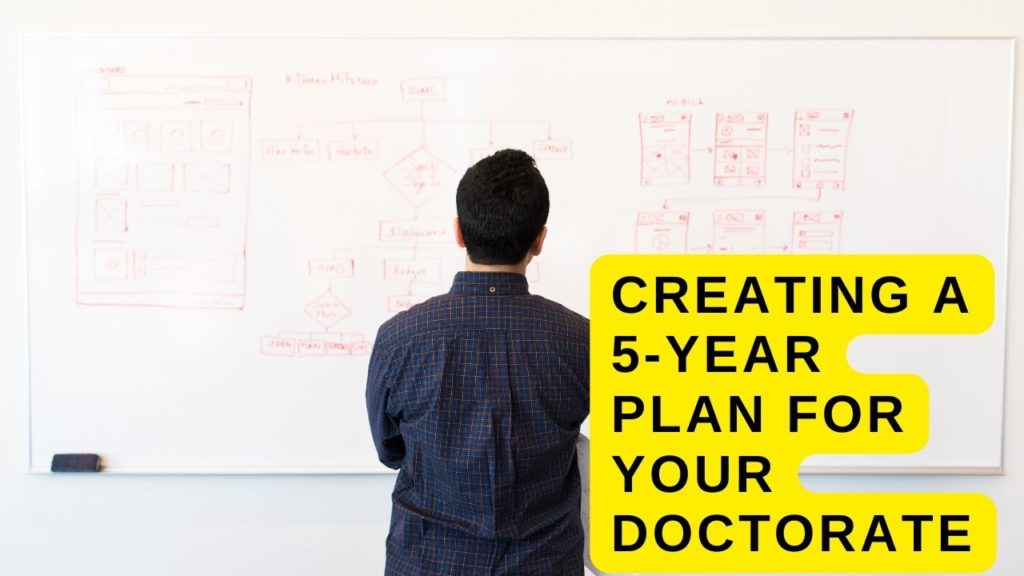
Creating a Five-year Plan for your doctorate By Felix Quayson Often, Doctoral students are faced with two career choices when they pursue their Doctorate; going to industry or staying in academia to work. However, for a lot of Doctoral students, they do not have a structured plan on how to apply their learning and experience to work in industry or academic settings. This is a result of failed planning and not having a structured plan on how to tailor their doctoral learning and experience to get ready for life after academic studies. Thus, I highly recommend to Doctoral students to create a five year plan for their degrees and careers. Having a plan makes your life and livelihood as a Doctoral student more structured and meaningful. It brings a sense of pride and joy, and awareness that you are the master of your livelihood. In this article, I outlined how and why creating a five year plan for your Doctoral study is the best decision you would ever make for yourself. “creating a five year plan for your Doctoral study is the best decision you would ever make for yourself.” THE FIVE-YEAR PLAN I would suggest to Doctoral students to either invest in electronic calender software, buy a calendar organizer book, or use the calendar app on their website/phone to set the five-year plan. I personally like to use my phone’s calendar app because I carry the phone with me all the time and I use it to organize my time on meetings, events, conferences, traveling, publications, writings, deadlines etc. I use the app calendar because it is instant, fast, and notifications are accounted for in my development as a scholar. Before the start of every semester, I set the time of my courses, events, scholarly activities such as research milestones, teaching, and service to the profession. When setting my calendar up, I choose the following reminder notifications for 10 minutes, 30 minutes, a day in advance, weekly, or recurring event for specific dates and time throughout the year or semester. For example, I set my due date for AERA Conference proposal due date and in the text I include what needs to be submitted, the goal of my proposal at the conference, and why it would help advance my scholarly work. I highly recommend to Doctoral students who have their eyes set on industry careers to invest in a calendar organizer to track their five-year plan, development, and progress. “Publishing can become a difficult milestone to achieve if you do not have a structured plan to gauge your performance and accountability.“ INCLUDE CONFERENCES IN YOUR FIVE-YEAR PLAN Doctoral students engage in conferences with their peers, faculty members, and professionals from industry and academia; however, they often miss the opportunity to track their interactions, progress, and learning after conference events. Having a structured plan would make it accessible for you to track your networks, conversations and follow-up with professionals you meet at conferences, and have clarity of focus on your career decisions. It is important for you to attend conferences to network with others regardless of your decision to stay in academia or go to industry. “Having a structured plan would make it accessible for you to track your networks, conversations and follow-up with professionals you meet at conferences, and have clarity of focus on your career decisions.” INCLUDE PUBLICATIONS IN YOUR FIVE-YEAR PLAN I would advice Doctoral students to set dates, goals, and milestones to publish in journals (be it industry or academic), write op-ed, write to magazines, and publish in newspapers. Writing and publishing can help professionals and executives in industry and academia to recognize you, your professional work, and the credibility that you have on topical relevance to issues. It signals to your peers in industry and academia that you are willing to learn to contribute to your field and profession. Publishing can become a difficult milestone to achieve if you do not have a structured plan to gauge your performance and accountability. “Doctoral students are good in everything in academia except for planning for their career after doctoral studies“ INCLUDE CAREER DEVELOPMENT IN YOUR FIVE-YEAR PLAN Doctoral students are good in everything in academia except for planning for their career after doctoral studies. Many Doctoral students suffer from career development and not having clarity on where they would like to work. In academic setting, their professors and advisors gaslight them about their exceptionalism with a Doctorate, and tying their worth of careers to their degrees. Career development is more than having an academic degree and it cannot be decided with gaslighting tendencies. I would advice Doctoral students to go to career centers, take career personality IQ tests, apply for jobs that fit your educational training, join professional associations and social networks, and network with professionals outside of the academic setting (especially for students who would like to go to industry). Having a plan would make it easier for you to track your career development progress. About the author: Felix Quayson has earned degrees in Education and Health, and professional certification in teaching English as a second/foreign language, research certifications from The Collaborative Institutional Training Initiative (CITI Program), and professional credentials in Education at Harvard Graduate School of Education where he is completing Certificate in Media & Technology for Education. Felix research interests is in Education Science focusing on workforce education, EdTech, STEM, & Higher Ed.
What’s wrong with the introduction of the Master’s dissertation? A comprehensive guide to writing the Introduction section

What’s wrong with the introduction of the Master’s dissertation? A comprehensive guide to writing the Introduction section By Abla Benbellal, Ph.D. Student at Algiers 2 University – Algeria The introductory section in all academic papers, including dissertations, plays a significant role in grabbing readers’ interest, establishing context for the topic under discussion and showing its relevance, significance and contribution to the area of interest. These different functions, however, make writing the introductory section one of the most difficult tasks for both the experienced and unexperienced writers. The aim of this article is threefold: (1) To discuss the most recurring difficulties that may be experienced by novice academic writers, (2) To suggest some practical solutions to overcome these difficulties, and (3) To cast light on the content of the general introduction according to the literature. 1. Major Difficulties Based on my experience as a teacher of academic writing and an examiner of Master’s dissertations for 4 years, most thesis introductions written by graduate students suffer from at least one of the following: 1.1. Difficulties in Establishing Context for the Research (Background of the study): It is called ‘background’ because researchers are supposed to review the existing literature on the aspect/topic being investigated. Nevertheless, it is often observed that many background sections are hastily written as the students neither provide sufficient details about the field of interest nor they present the key issues – referred to in previous studies – that would allow the reader to understand how the topic chosen came into existence. 1.2. Difficulties in Demonstrating the Research Significance and Gaps: The analysis of the general introductions showed that the following two main issues are often present in the research rationale section: Hasty Statement of the Benefits: In some introductions, the students fail to provide solid arguments to convince readers of the importance of their topic and clearly demonstrate the expected practical benefits that would contribute to the development of the existing field of knowledge. Absence of the Research Gap: Though it is an important step to demonstrate the significance of the study, most students tend to ignore it when writing the general introduction. This may imply that the students are just duplicating existing research; or they probably do not have a firm grasp of the body of knowledge in their domain. 1.3. Difficulties in Stating the Research Problem: The analysis of the introductory sections in Master’s dissertations reveals that stating the research problem often represents a daunting task for many novice researchers. The following are the major problems detected in writing the problem statement section: Brief and Incomplete Description of the Problem Being Studied: Despite its importance, the problem statement is not given the weight it deserves in some introductory sections of Master’s dissertations. The students often write just two or three sentences that do not provide a clear and detailed definition of the problem which answers the following questions: What (what aspect(s) the researcher is studying), Who (population/sample taking part in the study), Where (context of the study), and When (duration/period of time). Description of the Problem with Reference to Irrelevant Contexts: Many students tend to describe what happened/is happening in other contexts and overlook the context within which their studies take place. In other words, their problem statements look like a mini review of the issues discussed in previous related studies without considering the major differences between the characteristics of the context of those studies and their (i.e., students) own studies’ context. Overgeneralization and Assumptions without Concrete Evidence: When stating the problem, many graduate students tend to make assumptions without proof and draw conclusions that are too broad and illogical as they are based on what is happening in the limited context within which their studies take place. For instance, it is neither acceptable nor logical to state that all EFL undergraduates in the country encounter serious issues in reading comprehension while you (the researcher) are investigating the problem in one particular context in the country (e.g., The English Department at a particular university, a secondary school in the researcher’s hometown…etc.) 1.4. Difficulties in Formulating Good Research Questions: The analysis of the research questions’ sub-section in some introductions of Master’s dissertations reveals three major difficulties stated as follows: False Dichotomies: The majority of graduate students tend to frame their research questions in a way that two or more points/aspects are investigated at once and a single answer is required. This problem can be illustrated through the following example: What are the major challenges faced by EFL students in essay writing and to what extent can their writing performance be improved through the use of group work activities? This is a compound question which includes two separate questions: a) What are the major challenges…writing?, b) To what extent can their writing… group work activities? These two questions require two separate answers and, most probably, two different research instruments to collect data and be addressed satisfactorily. That is, the first question (Q a) can be investigated through using questionnaires or semi-structured interviews, while the second question (Q b) can be addressed through conducting an experiment in EFL writing classes to test the impacts of group work activities on writing. Ambiguity and Vagueness of the Research Questions: Many research questions formulated by graduate students are not clear and focused in a way that allows the researchers to direct their research and establish a clear relationship between the variables. Also, unclear research questions open the space for different interpretations by the readers who will exert great efforts to understand what exactly the researcher is investigating. Consequently, vague questions lead to vague answers and research outcomes which are untrustworthy and unreliable. Lack of Necessary Details about the Sample and the Research Site: Research questions in many introductions often do not provide information about the research participants (e.g., first/second/third year students at university, primary/middle/secondary school pupils or teachers…etc.) and the location where the study took place (i.e., a particular university, school, institution, company…etc.). Overlooking such details results in lack of precision and
Wellbeing advice for PhD students
Wellbeing advice for PhD students By Keira White The past 18 months have been a hailstorm (of hell fire) that I can pretty much guarantee not one of us saw hurtling towards us at 110mph. Additionally, if you’re currently in the midst of scaling the academic mountain that is a PhD, it may well have made your Ben Nevis resemble something more akin to a Kilimanjaro. A PhD is at the best of times challenging. If you’ve chosen to take up the gauntlet of achieving that elusive title of Dr so and so, then no doubt you knew it would be tough. From my point of view, what I wildly underestimated was the impact it could and has had on both my physical and mental wellbeing. The last 3 years have consisted of me single-handedly scouring the internet for tips on how to achieve that elusive “balance” that would allow me to peacefully chip away at my thesis in a zen like state whilst effortlessly juggling my full-time job, family and covid restrictions allowing, social life. I’m not here to tell you that I’ve reached academic Nirvana. I have, however, borrowed and even developed some of my own handy strategies that have helped to make this journey more enjoyable, despite the nagging voice in my head telling me that anything that is worthwhile must be intensely painful. “The past 18 months have been a hailstorm (of hell fire) that I can pretty much guarantee not one of us saw hurtling towards us at 110mph.” EXERCISE– This drum has been beaten to a bloody pulp but my goodness, for me there is no better head clearing reset. If you are expecting your body and mind to sit for prolonged periods at a laptop, furiously downloading articles you swear you’re going to read later (inside joke) then you should also plan some form of physical activity to balance the scales. You don’t need to be an iron man running, triathlon enthusiast, any form of exercise will do. Go for a gentle stroll in nature and smell some green things, take 10 minutes to sit and stretch your entire body which is no doubt coiled tighter than a grad student submitting their first paper to a journal. Whatever form of exercise you enjoy, make time for it, your body and for me more importantly your mind WILL thank you for it. “If you are expecting your body and mind to sit for prolonged periods at a laptop, furiously downloading articles you swear you’re going to read later (inside joke) then you should also plan some form of physical activity to balance the scales.” TAKE A DAY OFF-The very notion of a day off seems like sacrilege to most post grad students but you NEED a solid day that is not consumed by your thesis, you will be a more productive, happier version of yourself when you return to that SPSS spreadsheet or Word document tomorrow. If your mind wanders to your thesis, let it, we often do our best thinking when we give ourselves the space to do so, as long as you don’t let the guilt monster creep in and ruin your well deserved you time. OPEN YOUR LAPTOP-This one might seem counterintuitive considering my previous tip but throughout my PhD I have developed something I like to call the laptop ‘ICK’ the day after I’ve afforded myself a well-earned break. I get incredible anxiety about returning to my work and will spend all day using avoidance tactics whilst my cortisol levels hover between high and extremely high. It’s more than procrastination, it’s a genuine fear to even approach my workspace. The way I’ve tackled this is to set myself small tasks aka read one article and see how I feel, or a chapter in that book that’s been gathering dust for the last 4…okay 6 months. I instantly feel like I’ve been eased back in like a tepid bath and often feel able to carry on with other tasks now they don’t seem so daunting. “I get incredible anxiety about returning to my work and will spend all day using avoidance tactics whilst my cortisol levels hover between high and extremely high” ASK YOUR SUPERVISOR-Seems like a no brainer, right? But be honest, how many of you have stressed yourselves senseless over asking your supervisor something you don’t know because of the wealth of experience and published papers they have under their belt? C.S Lewis was wrong, Imposter Syndrome is the thief of joy and we all allow it to batter our delicate psyche’s with its horrid rusty hammer. I have had to repeatedly remind myself that I am learning, I am a student and I am not expected to know everything right now and rather than allow myself to remain in a limbo of I don’t knowsville, I have learnt to ask. So ask, that’s what they’re there for. The above tips have made this experience so much more enjoyable for me, therein lies the entire point though, you must follow the tips. Don’t read them and think oh lovely I’ll do that and then continue to work yourself into a fraught, tightly wound person who hasn’t received an ounce of natural vitamin D this year. I have been said person and it was a distinctly bad period for mind and body, here’s hoping you can avoid the pitfalls. Finally, you are impressive at the best of times for choosing to follow this path, let alone to do so throughout a global pandemic so go you…you got this. About the author: My name is Keira White and I am currently in the final year of my PhD at the University of Portsmouth. I am investigating quality of life experienced by parents and caregivers of children with speech, language and communication needs. I also have a degree in Human Communication Science and have a specific interest in research conducted in the areas of lived experience, wellbeing and the quality of